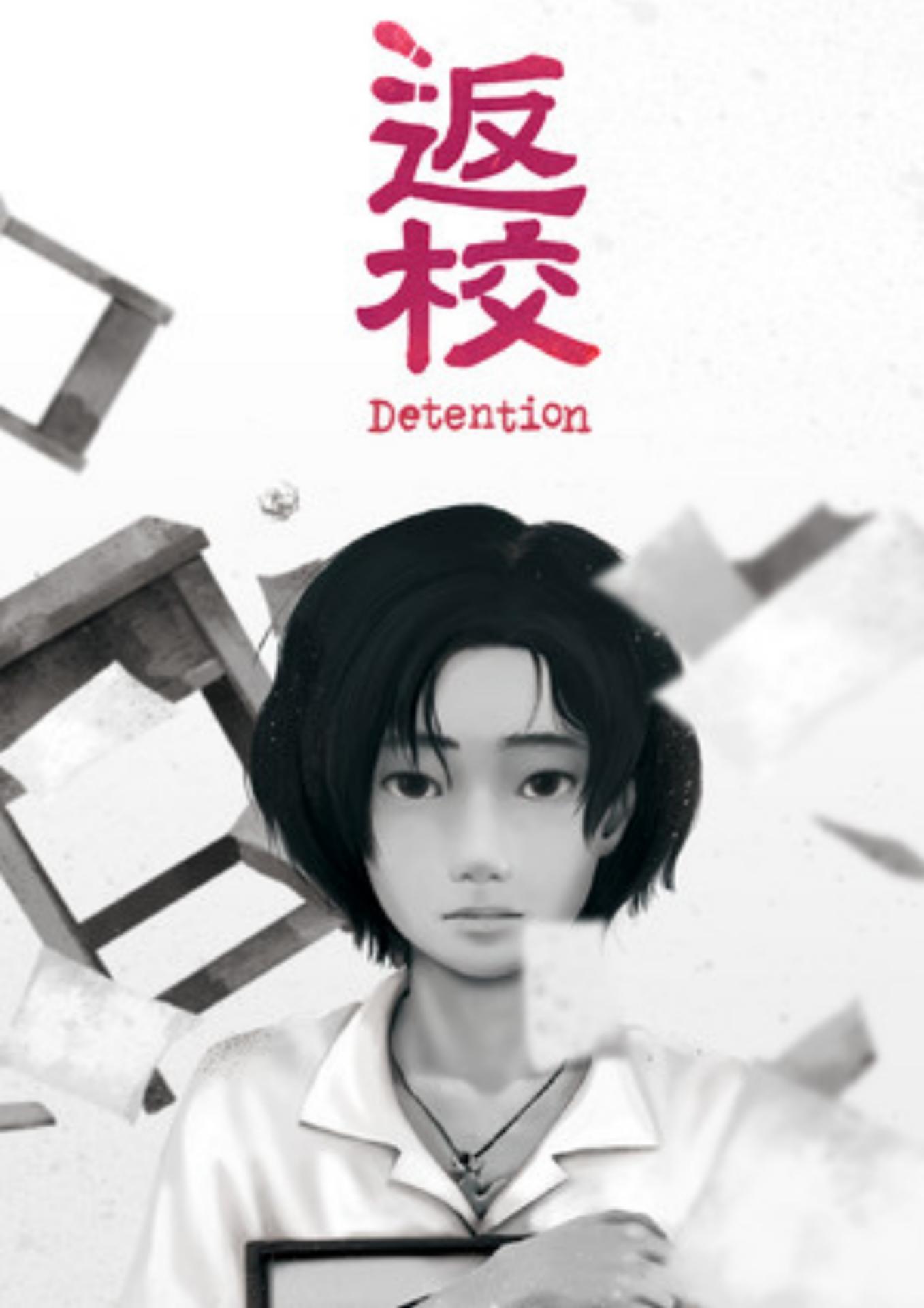
The rain has not stopped falling on Greenwood High School. It falls on the cracked tiles of the courtyard, on the rusted gates, on the blood-red river that has swallowed the only bridge out of this place. The corridors are empty, but they are not silent. Something moves in the dark between the desks—something with a long tongue and a lantern, something that was once a person and is now only a hunger that cannot remember why it is hungry. Two students are trapped here: a boy who fell asleep in class and woke to a world that no longer makes sense, and a girl who does not remember how she arrived or why the school keeps folding in on itself like a wound that will not close. This is not a story about monsters. It is a story about a girl who told a secret, a boy who paid for it, and a nation that taught its children to be afraid of the sound of their own voices.
Detention is a single, self-contained work—a Taiwanese horror story created by Red Candle Games and released in 2017—but it is also the gateway into a wider franchise that includes a feature film adaptation and a Netflix television series. The game itself is the foundation. Everything else grows from it. (Detention)
The White Terror: The History That Made the Nightmare
To understand Greenwood High School, you must first understand the world outside its walls. From 1949 to 1987, Taiwan lived under a period of martial law known as the White Terror. The government, controlled by the Kuomintang (the Nationalist Party that had retreated to Taiwan after losing the Chinese Civil War), treated any whisper of dissent as a threat to national survival. Reading a banned book could land a person in prison. Forming a study group could be interpreted as forming a Communist cell. Criticizing the government, even in private, could result in disappearance, torture, or execution. The White Terror was not a single event; it was an atmosphere, a weather system of fear that settled over everyday life and stayed there for nearly four decades. (Detention)
The game does not open with an explanation of this history. It opens with the ordinary machinery of repression: a military instructor named Instructor Bai walking into a classroom to ask a teacher about a book list. The students are silent. The teacher, Miss Yin Tsui-han, answers carefully. The scene is brief, almost mundane, but it establishes everything. This is a world where a list of books is a weapon, where a teacher’s private reading habits can become evidence of treason, and where children are taught to watch their elders for signs of disloyalty. The horror of Detention does not begin with a ghost. It begins with a curriculum. (Detention)
The Boy Who Fell Asleep and the Girl Who Cannot Wake Up
Wei Chung-ting is a junior at Greenwood High School. He is not a hero. He is a quiet, observant boy who belongs to a secret book club organized by Miss Yin and a counselor named Chang Ming-hui, a club that circulates banned literature and meets in the shadows of the auditorium. Wei falls asleep in class on the day a typhoon is scheduled to hit the mountain. When he wakes, the school is empty. The typhoon has arrived, the bridge out of the valley has flooded, and the only other person he can find is a senior named Fang Ray-shin, asleep on the auditorium stage. Ray is beautiful, distant, and seems to be sleepwalking through a life she does not fully inhabit. Wei does not know her well. He offers to wait out the storm with her. He leaves to find a telephone. And then the story shifts. (Detention)
The player does not experience the night from Wei’s perspective. The player experiences it from Ray’s. She wakes again on the auditorium stage, but the school has changed. The walls are stained. The lights are wrong. And Wei is hanging upside down from the ceiling, his throat cut, his blood draining into a ritual vessel. Ray performs the ritual. She collects his blood. She begins to walk. This is not a rescue. This is a purgatory. Ray is dead. She has been dead for some time. The school she is walking through is not the school as it was. It is the school as her guilt remembers it: a labyrinth of shame, a stage where she is the only performer, and an execution ground where the people she loved are killed again and again so that she can avoid admitting that she is the one who killed them. (Detention)
The Counselor, the Teacher, and the Book Club
The truth of Greenwood High School is a small tragedy that becomes a national one. Fang Ray-shin was a bright student whose home life was falling apart. Her father was abusive and unfaithful; her mother, in a moment of cold, practical fury, solved the problem by reporting him to the authorities and having him arrested. This is the first lesson Ray learns about power: that a list of names, handed to the right person, can make an inconvenient man disappear. Her grades slipped. The school sent her to counseling. The counselor was Chang Ming-hui, a gentle, idealistic young man who saw in Ray a wounded intelligence that reminded him of his own loneliness. They began a relationship. It was not a predator’s seduction. It was two people reaching for each other in a world that had taught them both to expect nothing. But Chang was already living a double life. He was helping Miss Yin smuggle banned books into the school and run the secret book club that Wei belonged to. When he ended the relationship with Ray—because he understood that a romantic entanglement with a student could expose the club, and because he believed he was protecting her—Ray overheard him arguing with Miss Yin in the auditorium. She heard fragments. She misunderstood. She believed that Miss Yin was her rival, that Chang had chosen another woman over her. (Detention)
Ray’s jealousy did not invent the White Terror, but it gave the White Terror a weapon. She convinced Wei to show her the book list. She copied it. And then she did what her mother had taught her to do: she handed it to Instructor Bai, the military officer stationed at the school, expecting that the list would get Miss Yin fired. Instead, the list became evidence of a Communist conspiracy. Wei and the other students in the club were arrested. Miss Yin fled the country and spent the rest of her life abroad as an activist, dying of lung cancer before she could return home. Chang was executed. And Ray, understanding at last what she had done, climbed to the roof of the school and jumped. (Detention)
The Lingered and the Lantern Specter: The Folklore of Guilt
The monsters that stalk the corridors of Detention are not random. They are drawn from Taiwanese and Chinese folklore, and they are shaped by Ray’s specific sin. The most common enemies are the lingered (魍魎), spirits so burdened by earthly attachments that they cannot reincarnate. In folklore, the lingered are pitiable things, souls trapped between worlds, and the game uses them as a mirror for Ray herself. She is the lingered. She is the soul that cannot move on because she refuses to accept what she has done. The Lantern Specter is another folkloric figure, a spirit that carries the dead to the underworld. In the game, it appears as a tall, lantern-bearing woman with a long tongue, a creature that hunts Ray through the school’s distorted halls. She is not a demon. She is a psychopomp, a guide to the land of the dead, and her presence in the school is a reminder that Ray’s journey is not a escape attempt. It is a reckoning. (Detention)
The game’s most distinctive act of survival is not combat but breath-holding. When a lingered approaches, Ray can hold her breath to avoid detection. The mechanic is simple, but it is also the story’s central metaphor made physical: in a world where speaking can get you killed, survival depends on silence. Ray’s entire tragedy began with a list, a document, a form of speech. The ghosts that hunt her are the consequences of words, and the only way to pass them is to stop breathing. (Detention)
The Purgatorial Loop: Two Endings, One Choice
Detention does not end with a monster being defeated. It ends with a question. In the final chapter, Ray confronts a shadow version of herself—the part of her that knows what she did and refuses to let her forget it. The shadow asks her a series of questions. If Ray denies her guilt, if she insists that she is not responsible, the shadow tells her that they are not the same person. Ray walks down a path beside a river of blood. Wei, Chang, and Miss Yin appear and tell her that the cycle will not end. She enters the auditorium, where an applauding audience waits for her. The shadow awards her a noose. Ray hangs herself, and the auditorium fades into its abandoned state in the present. The loop begins again. This is the Bad Ending, and it is not a punishment imposed by the game. It is the natural consequence of a soul that would rather repeat its pain forever than admit that it caused pain to others. (Detention)
If Ray accepts her guilt, the True Ending unlocks. She finds a paper airplane containing a message of love and farewell from Chang. She goes to his office and witnesses his arrest. He tells her that people should be born to live freely, without fear of oppression. The game shifts to the present. Wei Chung-ting is an old man. He survived. He was sentenced to fifteen years of imprisonment and hard labor, and he was pardoned after the White Terror ended. His journal reveals that Miss Yin spent the rest of her life abroad, fighting for the things she believed in, and died before she could come home. Wei walks through the school as it is now—empty, quiet, ordinary—and sits at his old desk. Ray’s ghost sits across from him. They do not speak. They do not need to. The loop is broken. (Detention)
The True Ending is not happy in any conventional sense. Ray is still dead. Chang is still dead. The years Wei lost in prison cannot be returned. But the ending offers something the Bad Ending refuses: the possibility of memory without repetition. Ray has acknowledged what she did. Wei has survived to carry the memory of the people who did not. The school is no longer a purgatory. It is just a school, and the ghosts are free to leave.
The Wider Franchise: Film, Television, and the Duty of Memory
The story of Detention has expanded beyond the game. A feature film adaptation, directed by John Hsu and released in 2019, retells the story from a slightly different angle, giving more weight to Wei’s perspective and to the mechanics of the book club’s resistance. The film is widely considered one of the finest video game adaptations ever made, not because it reproduces the game’s imagery, but because it understands the game’s purpose: to make the audience feel the weight of a history that many would prefer to forget. A Netflix television series followed, extending the story into new territory while keeping the White Terror and its aftermath at its center. (Detention)
These adaptations do not replace the game. They deepen it. The game is the intimate, interior experience—Ray’s purgatory, her guilt, her silence. The film and the series are the outward-facing versions, the ones that show the world outside the school, the soldiers, the families, the country that allowed the White Terror to happen and then spent decades refusing to talk about it. Together, they form a single project: a refusal to let the past be buried. (Detention)
Understanding the Full Picture
The tragedy of Detention is not that Ray did something unforgivable. It is that she did something ordinary. She was hurt, she was jealous, and she used the machinery of oppression that her society had placed within her reach. Her mother taught her that reporting a man could solve a problem. The school taught her that lists of names had power. The government taught her that some books were dangerous. Ray did not invent the White Terror. She was a child shaped by it, and when she was given a chance to use it against someone who had wounded her, she did not hesitate. The horror of the game is not that monsters exist. It is that the monsters are made from the ordinary cruelties of ordinary people, and that the line between victim and perpetrator is thin enough to cross without noticing. (Detention)
What connects every version of this story—the game, the film, the series—is the idea that memory is a moral obligation. Wei survives because someone has to remember. Miss Yin dies abroad because the truth of what happened was more important to her than a quiet life. Chang dies because he believed that books and ideas were worth dying for. Ray’s ghost lingers because she cannot face what she did, and she is only freed when she stops running from her own shadow. The White Terror was a system designed to make people forget, to make them afraid to speak, to make them complicit in their own silencing. Detention is a refusal of that forgetting. It is a story that says: the loop only ends when someone is willing to say, out loud, this is what happened, and this is what I did. (Detention)
For a newcomer, Detention is complete in itself. There is no prior game to play, no expanded universe to navigate, no chronology to untangle. The game is the beginning, the middle, and the end of Ray’s story, and the film and television series are variations on the same theme rather than continuations. If you wish to understand it, begin with the game. Walk the corridors of Greenwood High School. Hold your breath when the lingered pass. Listen to the silence. And when the shadow asks you what you did, do not look away.