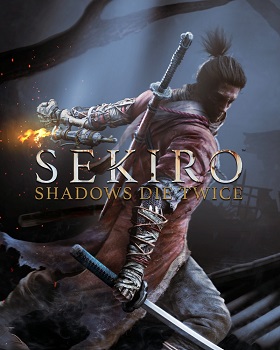
The mountain province of Ashina is a cold, beautiful, dying place. Snow falls on its cedar forests and its ruined castle walls, and the wind carries the smell of iron and pine and old blood. For a generation, this land has been free—wrested from the crushing grip of a distant empire by a single, legendary swordsman named Isshin Ashina. But Isshin is old now, and sick, and the empire he once humbled has returned with a vast, modern army to reclaim what it lost. The war is no longer a matter of swords and honor. It is a matter of survival, and in such a war, men will reach for anything—any power, any curse, any ancient and terrible gift—to keep their homes from burning.
That desperation is the true villain of Sekiro: Shadows Die Twice. Not a dark lord, not an empire, but the simple, human refusal to accept death. The story begins with a boy who cannot die and ends with the question of whether he should. What follows is the complete history of that story: the ancient dragon whose blood made immortality possible, the clan that tried to wield it, the shinobi torn between loyalty and conscience, and the four ways that story can end.
The Divine Dragon and the Two Poisoned Gifts
In an age before memory, a Divine Dragon came to Ashina from a place called simply “the West.” It did not conquer. It rooted itself in the land, and from its presence flowed two sources of power that would shape every tragedy to come. The first was the Dragon’s Heritage, a bloodright that passed to certain rare individuals—the Divine Heirs—who could bestow immortality upon others and bind them to an oath. The second was the Rejuvenating Waters, a modified form of the sacred springs that flowed from the dragon’s resting place. Both were gifts. Both were poison. (Sekiro: Shadows Die Twice)[reference:0]
The Rejuvenating Waters did not grant true immortality. They granted a kind of stubborn, rotting persistence. Those who drank too deeply did not die, but they did not live either. Their bodies became host to centipedes—crawling, writhing things that nested in their flesh and refused to let them expire. The Senpou monks on the mountain above Ashina drank the waters in their quest for enlightenment and became something far from enlightened: immortal husks, sitting in meditation for centuries, their minds worn away by the endless repetition of a life that would not end. The Guardian Ape in the Sunken Valley drank from a poisoned pool and became a snarling, headless thing that could not be killed, mourning a mate who had died naturally long ago while the centipede inside its body refused to let it join her. The Corrupted Monk who guards the path to the Fountainhead Palace is infested with centipedes, a once-holy woman now a puppet of her own undeath. Everywhere the Rejuvenating Waters touch, life becomes a cage. (Sekiro: Shadows Die Twice)[reference:1][reference:2]
The Dragon’s Heritage was different, and in some ways worse. It did not turn a person into a husk. It made them truly, impossibly immortal—and it spread Dragonrot, a wasting plague that crept through the land wherever the Heritage was used. Those bound by an Immortal Oath to a Divine Heir could rise from death again and again, but each resurrection drained life from the world around them. The oath itself was not a gift of immortality; it was a form of life-stealing. The oathbound did not cheat death. They borrowed life from others, and the debt was always paid in sickness and suffering by the people who had the misfortune to live nearby. (Sekiro: Shadows Die Twice)[reference:3][reference:4]
This is the central metaphor of the entire story, the idea upon which every character and every tragedy is built: immortality is stagnation. To refuse death is to refuse change, to refuse growth, to refuse the natural movement of a world that must be allowed to end so that something new can begin. The Dragon’s Heritage is not a blessing. It is a closed loop, a wheel that turns forever without going anywhere, and everyone caught in it—the monks, the ape, the nobles of the Fountainhead Palace—is slowly being ground into something less than human.
Isshin Ashina and the Dream of a Free Province
The man who gave Ashina its freedom was not a sorcerer or a god. He was a swordsman, and his name was Isshin Ashina. Twenty years before the story begins, Isshin led a rebellion—the War of Northern Subjugation—against the empire that had swallowed his homeland. He was not a noble by birth. He was a killer who had learned his craft in a hundred battlefields, and he gathered around him a collection of misfits and monsters: Owl, a shinobi with no master and no conscience; Lady Butterfly, an illusionist who moved on threads of silk; the Sculptor, a shinobi of such terrifying violence that men called him Sekijo, the One-Armed Orangutan; and Oniwa, a general who would die for him without hesitation. Together they broke the empire’s army and carved out a small, stubborn kingdom in the mountains. (Sekiro: Shadows Die Twice)[reference:5][reference:6]
Isshin was not a good man in any simple sense. He killed more people than most wars, and he did it with a smile and a flask of sake. But he believed in something that the empire did not: that a people had the right to govern themselves, even badly, even poorly, even if it meant poverty and obscurity. He grew old, and sick, and he watched the empire gather its strength for a second attempt. And he made a choice that would define the rest of his life: he refused to use the Dragon’s Heritage to save his own kingdom. He had seen what immortality did to people. He had watched the Senpou monks rot into husks and the Fountainhead nobles become parasites. He would rather see Ashina die as a free nation than live as an abomination. (Sekiro: Shadows Die Twice)[reference:7][reference:8]
His adopted grandson did not agree.
Genichiro Ashina and the Weight of a Name
Genichiro Ashina was not born to the clan. He was found as an orphan on a battlefield, the same kind of battlefield where Owl would later find a boy and name him Wolf. Isshin took him in, gave him the Ashina name, and raised him as an heir. Genichiro grew up in the shadow of a legend, and he loved Ashina with a love that had no room for reason. To him, the province was not a political idea. It was his father, his home, his entire identity. And when the empire returned with its rifles and its cannon and its endless soldiers, Genichiro looked at the old, sick man who had taught him everything and decided that the old man was wrong. (Sekiro: Shadows Die Twice)[reference:9]
Genichiro sought the Dragon’s Heritage not for himself, but for Ashina. He did not want to live forever. He wanted the power to protect his people, and he was willing to pay any price—to bind himself to a Divine Heir, to spread Dragonrot across the land, to become a monster—if it meant the Ashina name survived. He kidnapped Kuro, the young Divine Heir living in hiding under Isshin’s protection, and demanded the power of the Heritage. When Kuro refused, Genichiro did not torture him or threaten him. He simply waited, and prepared, and tried again. Genichiro is not a villain in the ordinary sense. He is a man who loves something so much that he will destroy it rather than let it change. (Sekiro: Shadows Die Twice)[reference:10]
He is also the story’s great warning. Genichiro is what happens when a person refuses to let a place be mortal—when they decide that a nation is more important than the people who live in it. He would rather turn Ashina into an eternal, rotting husk than let it pass into history. And in the end, his desperation leads him to a power he cannot control.
The Wolf, the Owl, and the Iron Code
The protagonist of this story is a shinobi with no name. He was found as a child on a battlefield by Owl, a masterless killer who saw potential in the boy’s empty eyes. Owl gave him the name Wolf, raised him as a tool, and taught him the Iron Code: a shinobi’s father is above all things, and a shinobi’s lord is above his own life. Wolf was not taught to think. He was taught to obey. And for most of his life, he obeyed without question. (Sekiro: Shadows Die Twice)[reference:11]
Owl was not a father in any warm sense. He was a trainer, a handler, a man who saw relationships as transactions. He assigned Wolf to serve Kuro, the young Divine Heir, because serving a Divine Heir meant proximity to the Dragon’s Heritage, and proximity to power was the only thing Owl truly valued. He also arranged for Lady Butterfly, Wolf’s childhood teacher and a woman Kuro trusted, to turn against the boy. Owl’s plan was simple: let Wolf and Butterfly fight, let one of them die, and then step in to “rescue” Kuro and claim the role of protector for himself. He did not count on Wolf’s stubbornness, or on Kuro’s kindness. (Sekiro: Shadows Die Twice)[reference:12][reference:13]
Three years before the story begins, Owl’s betrayal reached its climax. He stabbed Wolf in the back and left him for dead. But Kuro, the boy Wolf had been assigned to protect, did something no Divine Heir had ever done for a shinobi: he gave Wolf the Dragon’s Heritage. He bound Wolf to himself with an Immortal Oath, not as a master binds a servant, but as a friend saves a friend. Wolf rose from death, and the story of Sekiro—the one-armed wolf—began. (Sekiro: Shadows Die Twice)[reference:14]
The name Sekiro was given to Wolf by Isshin himself, late in the story, after Wolf has lost his left arm and replaced it with a prosthetic. It means “one-armed wolf,” and it is a name of respect, not pity. Isshin looks at this silent, scarred killer and sees something familiar: a man who has been used by everyone around him and is only now beginning to ask whether he has a choice. (Sekiro: Shadows Die Twice)[reference:15]
The Sculptor, Emma, and the Demon in the Flames
The man who saves Wolf after Genichiro cuts off his arm is the Sculptor, a former shinobi who lives in an abandoned temple on the edge of Ashina. He was once Sekijo, Isshin’s most feared enforcer, a killer of such ferocity that the mere memory of his violence makes men lower their voices. But Sekijo was consumed by Shura—a Buddhist term for a being of endless slaughter, a soul that kills not for a cause but because killing has become its only language. Isshin stopped him by cutting off his arm, and the Sculptor retreated to his temple to carve statues of the Buddha, hoping that devotion could hold back the rage inside him. (Sekiro: Shadows Die Twice)[reference:16][reference:17]
The Sculptor is kind to Wolf. He gives him a home, a prosthetic arm, and the tools to fight. He also carries a terrible secret: the rage is still there. When the empire’s invasion reaches its final, desperate stage, the Sculptor loses his battle with Shura and becomes the Demon of Hatred, a towering, flame-wreathed creature of pure violence. He is not a villain. He is a victim of the same war that created Wolf, and the tragedy of his transformation is that it could have been avoided if anyone had ever treated him as a person rather than a weapon. (Sekiro: Shadows Die Twice)[reference:18][reference:19]
Emma is the woman who serves as Isshin’s doctor and confidante, and she is the closest thing the story has to a moral center. She was an orphan, rescued by the Sculptor in the aftermath of the war, and she grew up watching him struggle with his Shura. She learned medicine from Dogen, a brilliant physician, and she learned swordsmanship from Isshin. She is gentle, but she is not soft. When the time comes, she will stand in Wolf’s way if she believes he is making the wrong choice, and she will do it with a blade. Emma represents the possibility of a life beyond the Iron Code—a life where loyalty is chosen rather than commanded, and where killing is a last resort rather than a first instinct. (Sekiro: Shadows Die Twice)[reference:20]
The Senpou Monks and the Corruption of Faith
High above Ashina, on the slopes of Mount Senpou, sits a temple of Buddhist monks who once sought enlightenment through discipline and meditation. By the time Wolf arrives, they have abandoned enlightenment for something far more desperate. The Senpou monks have discovered the Rejuvenating Waters, and they have decided that immortality is the true path to salvation. They drink the waters, infuse their bodies with centipedes, and sit in endless meditation, waiting for a death that will never come. They have also begun experimenting on children, attempting to create new Divine Heirs—new vessels for the Dragon’s Heritage—so that they can control the power of immortality for themselves. (Sekiro: Shadows Die Twice)[reference:21][reference:22]
The Senpou Temple is a portrait of what happens when faith becomes a technology. The monks no longer believe in anything beyond their own survival. They have turned a religion of compassion into a machine for producing undying soldiers, and the children they experiment on—the Divine Children—are the victims of that machine. One of these children, the Divine Child of Rejuvenation, becomes one of Wolf’s most important allies. She is not human in any ordinary sense, but she is kind, and she understands the horror of what the monks have done. She will play a crucial role in one of the story’s endings. (Sekiro: Shadows Die Twice)[reference:23][reference:24]
Mibu Village and the Fountainhead Palace: The Rot Beneath the Water
Below Senpou, in a valley choked with mist and silence, lies Mibu Village. Its people are not quite dead, but they are not quite alive either. They drink from a stream that flows down from the Fountainhead Palace, and the water has made them something other than human—hollow, hungry things that suck the youth from any traveler who lingers too long. The village is a waystation for the doomed, a place where the Rejuvenating Waters have done their quiet work for generations. (Sekiro: Shadows Die Twice)[reference:25]
And above Mibu, at the summit of the mountain, sits the Fountainhead Palace, the ancient home of the Okami—the noble clan who first worshipped the Divine Dragon. The palace is beautiful in the way a corpse is beautiful: perfectly preserved, utterly still, and profoundly wrong. The Okami nobles are immortal, but their immortality has made them parasites. They no longer create, no longer grow, no longer love. They simply exist, draining the life from the few humans who stumble into their realm. The Corrupted Monk guards the bridge to the palace, a once-holy woman now little more than a centipede’s puppet. And at the heart of the palace, in the Divine Realm, the Divine Dragon itself waits—a vast, ancient, one-armed creature of bark and blossom, the source of all the suffering that has flowed through Ashina for centuries. (Sekiro: Shadows Die Twice)[reference:26]
The Dragon is not evil. It is simply indifferent. It came to Ashina, rooted itself in the land, and began to give off power the way a tree gives off sap. It did not ask to be worshipped. It did not choose to create the Rejuvenating Waters or the Dragon’s Heritage. It is a natural force, as impersonal as a river or a storm, and the tragedy of Ashina is that human beings have spent generations trying to turn that force into a tool. The Dragon is not the villain. The desire to control it is.
The Four Endings: What It Means to Let Go
The story of Sekiro: Shadows Die Twice does not have a single ending, because the question at its heart—whether immortality should be allowed to continue—cannot be answered in only one way. Each ending is a different answer, and each one reveals something different about the characters who choose it. (Sekiro: Shadows Die Twice)[reference:27]
The first is the Shura ending, the darkest path. At the height of the story, Owl offers Wolf a choice: abandon Kuro and join him in a bid to seize the Dragon’s Heritage and conquer Japan. If Wolf accepts, he breaks the Iron Code—not by betraying his father, but by choosing his father over his lord, and in doing so he becomes a Shura, a demon of slaughter. Wolf kills Emma, kills Isshin, and stands beside Owl as Ashina burns. The ending is a nightmare not because Wolf becomes evil, but because he becomes nothing—a weapon with no will of its own, finally pointed in the direction its maker always intended. (Sekiro: Shadows Die Twice)[reference:28]
The second is Immortal Severance, the bittersweet default. Wolf remains loyal to Kuro, fights his way through the empire’s invasion, and reaches the Divine Realm to obtain the Divine Dragon’s Tears. He brings the Tears to Kuro, and Kuro uses them to sever the Dragon’s Heritage from himself—ending his own immortality and the spread of Dragonrot forever. But the cost is Kuro’s life. The boy who saved Wolf dies so that the world can be free of the curse, and Wolf is left alive, kneeling in the snow, holding the body of the only person who ever treated him as more than a tool. It is a heroic ending, but it is not a happy one. (Sekiro: Shadows Die Twice)[reference:29]
The third is Purification, the most personal sacrifice. If Wolf retrieves the Everblossom from the memory of Hirata Estate, he can perform a ritual that allows Kuro to sever the Heritage without dying—but only if Wolf takes the curse into himself. Wolf becomes the vessel of the Dragon’s Heritage, immortal and alone, and Kuro lives. It is an ending about love, and about the willingness to carry a burden so that someone else does not have to. (Sekiro: Shadows Die Twice)[reference:30]
The fourth and most mysterious is Dragon’s Homecoming, the “true” ending. If Wolf follows the Divine Child of Rejuvenation’s instructions, gathers the Everblossom and the Frozen Tears, and returns the Divine Dragon’s power to its place of origin in the West, he can break the cycle entirely. Kuro is saved, the Heritage is returned to the Dragon, and Wolf and the Divine Child leave Ashina together, carrying the unconscious Kuro to a distant land. It is the only ending in which no one has to die, and it is the only ending that offers the possibility of a future beyond the curse. It is not a victory. It is a beginning. (Sekiro: Shadows Die Twice)[reference:31]
Understanding the Full Picture
The ultimate tragedy of Sekiro: Shadows Die Twice is that every character in it is trying to save something they love, and every one of them is willing to pay a price that no one should have to pay. Isshin wants to save Ashina’s freedom, and he pays for it with his health, his legacy, and eventually his life. Genichiro wants to save Ashina’s existence, and he pays for it with his humanity. Owl wants to save nothing but his own ambition, and he pays for it with the only person who ever trusted him. The Sculptor wants to save himself from his own rage, and he fails. Kuro wants to save Wolf from the curse he himself inflicted, and he is willing to die to do it. Wolf, the silent shinobi at the center of it all, wants only to obey—and the entire story is about him learning that obedience is not the same thing as loyalty, and that a weapon can choose what it is pointed at.
This is a story about stagnation. The Divine Dragon’s power does not create life; it preserves it, endlessly, without change or growth or end. The monks who drink the Rejuvenating Waters do not become enlightened; they become fossils. The nobles of the Fountainhead Palace do not become gods; they become parasites. Ashina itself, under Isshin, is a beautiful, stubborn, doomed thing—a province that won its freedom and then spent twenty years preparing to lose it again. The only way forward, the story suggests, is to let go. To let the old die. To let the curse end. To accept that mortality is not a flaw to be corrected but a condition to be lived with.
And yet the story does not condemn the desire to save what you love. It simply asks what you are willing to become in order to do it. Wolf can become a Shura, a mindless instrument of slaughter. He can become a sacrifice, carrying the curse so that Kuro can live. He can become a mourner, holding the body of a boy who chose to die. Or he can become something new—a traveler, a guardian, a man who walks away from the only home he has ever known, carrying a sleeping child toward a future that no one can predict. That last path is the hardest, and it is the only one that offers hope.
For a newcomer, Sekiro: Shadows Die Twice is a complete story in a single work. There are no sequels, no spin-offs, no expanded universe to navigate. The entire narrative—the ancient dragon, the fall of Ashina, the tragedy of Owl, the four endings—is contained within one experience. If you wish to understand it, begin at the beginning: follow Wolf from the well where he wakes, through the burning Hirata Estate, up the castle walls, into the sunken valley and the mist-choked village and the silent palace at the top of the world. The story will ask you, again and again, whether immortality is a gift or a cage. The answer it offers is not simple, and it is not comforting. But it is true, and it is earned, and it will stay with you long after the snows of Ashina have melted away.